Pillar Guide · Tile Roof Repair
Tile Roof Repair in Beaumont
On a tile roof, the tiles are the rain screen and the underlayment is the waterproofing, and most leaks live in the layer you cannot see. This guide explains tile breakage, slipped tiles, and underlayment failure in Beaumont, and how repairs are done without damaging the roof further.
The Problem
Why does a tile roof leak when the tiles look fine?
Tile roofing works differently from shingle or metal, and misunderstanding it leads to years of wrong repairs. The clay or concrete tiles overlap to shed most rain and protect the layers below from sun, but they are not sealed to each other, and wind driven Beaumont rain passes between them by design. The true waterproof barrier is the underlayment and flashing system beneath the tiles. When a tile roof leaks, the fault is usually in that hidden layer, a perished underlayment section, a flashing gap, or a valley lining, while the tiles above look handsome and complete.
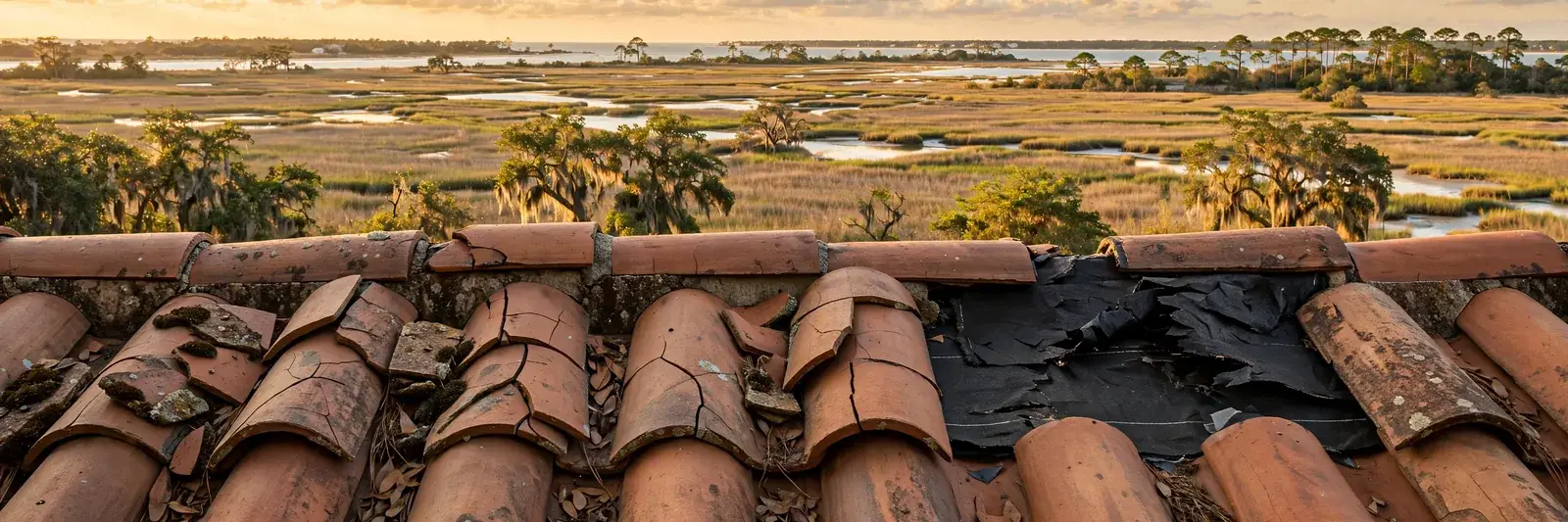
The tiles themselves still matter, because cracked, slipped, or missing tiles expose the underlayment to ultraviolet light and direct rain volume it was never meant to carry alone. In Gulf sun, exposed underlayment degrades quickly, so a single broken tile after a storm is a small, urgent job, not a cosmetic one. Foot traffic is the other great local hazard, tiles crack under careless feet during other trades work, and each cracked tile restarts the exposure problem at a new point the homeowner may never be told about.
Aged tile roofs in Beaumont present a particular pattern. The tiles may have decades left in them while the original underlayment beneath has reached the end of its life across whole slopes. Leaks then appear at several points in the same seasons, and replacing individual tiles does nothing because the barrier below them has failed generally. Diagnosing that stage correctly, tiles sound, underlayment gone, is the most valuable judgement a tile inspection makes, because the repair conversation changes completely at that point.
Causes
What causes tile roof leaks and damage in Beaumont?
Tile roof problems split between the visible tiles and the hidden waterproofing, and Beaumont weather works on both. These are the failures contractors look for.
Cracked and broken tiles
Tiles crack from storm debris impact, falling branches, foot traffic, and occasionally from stress at their fixing points. A cracked tile channels water directly onto the underlayment and breaks the overlap pattern around it. Because tiles are brittle, one breakage event often cracks neighbours that only show on close inspection, so the survey around any broken tile matters as much as the tile itself.
Slipped and displaced tiles
Fixings corrode or fail, mortar bedding crumbles, and tiles slide out of position, opening gaps in the rain screen and exposing underlayment and battens. Slipping often starts at ridges, verges, and around details where bedding does most of the work. A displaced tile also loads its neighbours unevenly, so a small slip left alone tends to become a loose area.
Underlayment failure
The felt or membrane under the tiles ages, dries, and splits, fastest where tiles are cracked or slipped and sun reaches it, and eventually across whole slopes. Once the underlayment is open, rain that passes the tiles, as it is designed to do, reaches the decking. This is the deepest common tile roof failure in Beaumont and the one most often misdiagnosed as a tile problem.
Valley and flashing failure under tiles
Valleys and junctions on tile roofs are lined and flashed beneath the tile surface, and those hidden linings corrode and split in humid conditions while the tiles above hide the evidence. Debris collects in tile valleys and holds damp against the lining. Leaks from these points can run for a long time because neither homeowner nor a casual inspection can see the failed component.
Ridge and hip bedding failure
Ridge and hip tiles are traditionally bedded and pointed with mortar, which cracks and falls away in sections under thermal movement and age. Open ridge bedding admits driven rain at the highest, most exposed lines of the roof and lets individual ridge tiles work loose. Repointing alone over failed bedding is a short lived repair, the bedding itself needs renewal where it has parted.
Debris dams and blocked drainage paths
Leaves, moss, and storm debris lodge between tiles and in valleys, holding moisture against the underlayment and diverting water sideways under the tile laps. In Beaumont tree cover and humidity, growth between tiles is common and it lifts tiles as roots and stems thicken. Clearing and treating these dams is maintenance, but left for years it becomes a leak cause in its own right.
The Process
How is a tile roof repaired without breaking more tiles?
Walk the roof the tile way
Inspection and repair on tile requires walking on the strong points of the tiles, using boards or pads where needed, and lifting tiles to see the underlayment rather than judging from the surface. The contractor surveys breakage, slipping, ridge bedding, and the hidden valley and flashing lines. An inspector who will not lift tiles cannot assess a tile roof, and that limitation should be stated, not hidden.
Replace broken and slipped tiles
Damaged tiles are removed by easing the surrounding courses, and sound replacements of the same profile are fitted and fixed correctly, not simply laid in place. Where an exact profile match is unavailable, tiles are often moved, sound originals placed in the most visible areas and the closest match used in discreet positions, a practical approach explained to you in advance.
Renew the failed waterproofing
Where underlayment or valley lining has failed, tiles over the affected area are lifted and stacked, the old layer is removed, decking is checked, and new underlayment and linings are fitted before the tiles are relaid. This is the substantial form of tile repair, and it restores the barrier the whole system depends on in that area.
Rebed ridges and clear drainage
Failed ridge and hip bedding is cut out and renewed, loose tiles refixed, and valleys and tile courses cleared of debris dams. The finished roof is checked course by course for seating and overlap. You receive a note on underlayment condition by area, since that hidden layer, not the tiles, will decide the future of the roof.
In Detail
What should tile roof owners in Beaumont watch for?
The single most expensive tile habit is letting other work happen on the roof without tile care. Air conditioning, chimney, and antenna work all send people across tiles, and cracked tiles from a service visit may not be noticed for months, by which time Gulf sun has been working on the exposed underlayment daily. Tell any trade the roof is tile, ask how they will access their work, and have the route checked afterwards. Many Beaumont tile leaks begin as a sentence nobody said to a visiting technician.
Matching is the other standing issue. Tile profiles and colours from older roofs, including many fitted in this region years ago, may be discontinued, and a repair is only as neat as the match available. Contractors often source reclaimed tiles for older profiles, which is a normal and sensible practice in tile work. Discuss matching before work starts, including the option of moving original tiles to prominent slopes, so the finished appearance is a decision you made rather than a surprise you received.
Local Conditions
How does Beaumont weather drive tile roof repair?
For tile roof repair, Beaumont's climate is not background detail, it is the cause behind most calls. ['architectural asphalt shingle, the most common covering on Beaumont homes', 'composition and three tab asphalt shingle, still found on older and smaller homes', 'standing seam and panel metal, increasingly used as a storm resistant replacement, with at least one documented metal roof on an Amelia area home', 'cedar shake and clay tile, present on a minority of historic era homes, including a documented terra cotta tile roof in the neighbouring Caldwood addition'] Those conditions shorten shingle life compared with drier parts of Texas, make flashing and ventilation details critical, and mean roof deck rot is a common finding when older roofs in the city's mid century neighbourhoods are torn off.
Atlantic hurricane season runs from June 1 through November 30. Hurricane Harvey in 2017 stalled over Southeast Texas and caused severe flooding across the Beaumont area, flooding thousands of homes, while a United States rainfall record of 60.58 inches was recorded at nearby Nederland. A contractor who works in Beaumont reads that weather history in the roof itself, which is why local experience matters for tile roof repair.
Beaumont housing spans oil boom era historic homes from the early 1900s in and around the Oaks Historic District, mid century ranch and bungalow housing across South Park, Pear Orchard and the North End, and late twentieth century tract subdivisions on the west side in areas such as Dowlen West, Amelia and Calder Highlands. ['Lamar University', 'Neches River, along the east side of the city', 'Interstate 10, crossing Beaumont east to west', 'Dowlen Road retail corridor, including Parkdale Mall', 'Spindletop, site of the 1901 oil gusher, marked by the Spindletop Gladys City Boomtown Museum', 'McFaddin Ward House Museum on the Calder Avenue corridor', 'Texas Energy Museum in downtown Beaumont', 'Tyrrell Park and the Beaumont Botanical Gardens and Cattail Marsh area in the southwest of the city'] None of that makes tile roof repair unusual work in Beaumont. It makes it routine work, done by contractors who see the same Gulf weather patterns on roofs across the city every week.
Cost Factors
What does tile roof repair cost in Beaumont?
Tile repair pricing reflects the care needed to work on a brittle surface and the state of the hidden layers. These rows cover typical Beaumont tile jobs.
Ranges are general guidance, not a quote. The contractor confirms the final price after inspecting your roof.
When To Call
When should a tile roof problem be seen to in Beaumont?
Call when you find tile pieces in the yard or gutters, see a slipped or missing tile, notice ridge mortar on the ground, or develop a leak under a tile section. In this climate an exposed underlayment patch degrades in a single summer of Gulf sun, so a broken tile is a prompt job even though the tile itself looks like a small thing. Waiting converts a tile replacement into an underlayment repair at several times the cost.
Also book an inspection when a tile roof is new to you or when leaks appear at more than one point in a season. Multiple leaks on tile usually mean the hidden barrier, not individual tiles, is failing, and that assessment changes the plan from patching to section renewal. Knowing which stage your roof is at is worth more than any single repair on it.
Go Deeper
Where does tile roof repair go from here?
City Page
Tile Roof Repair in Beaumont, TX
The local service page for tile roof repair across Beaumont, with first steps, response and coverage.
Open the city page →Neighbourhood
Tile Roof Repair in West End
How tile roof repair plays out in West End, with the problems local homes see most.
Tile Roof Repair in West End →Cost Guide
Roof Repair Cost
Typical Beaumont price ranges for this kind of repair and what moves the price.
Read the cost guide →Tile Roof Repair by neighbourhood
The Tile Roof Repair in Beaumont, TX city page covers the whole city. Each neighbourhood page below looks at tile roof repair on its own streets, with its own housing and exposure.
FAQ
Tile Roof Repair questions, answered
By itself, over sound underlayment, a broken tile may not leak immediately, because the barrier below still works. Its danger is exposure, sun and full rain volume now reach underlayment designed to be protected, and in Beaumont that protection loss shows within a season or two.
So the answer is that the tile is urgent even when the ceiling is dry. Replacing it promptly is one of the clearest examples in roofing of a small cost preventing a much larger one.
Because the tile layer passes more water in heavy, wind driven rain, and a weakened underlayment or valley lining that copes with the modest flow of light rain is overwhelmed by the volume of a Beaumont downpour. The system has a threshold, and the storm crosses it.
That pattern is diagnostic, it points under the tiles rather than at them. The repair lifts the affected area and renews the barrier or lining, after which the same storm volume should be handled as the roof originally handled it.
Surface sealing a cracked tile is at best a short holding measure. The crack flexes with temperature, the seal breaks, and the tile continues to channel water onto the underlayment. Replacement with a sound tile of the right profile is the durable repair and is usually not expensive as a single item.
Where matching tiles genuinely cannot be sourced for a visible area, discuss options with your contractor, reclaimed stock, moving tiles between slopes, or the closest profile. Those are appearance decisions to make openly, not reasons to glue and hope.
It depends on the original material and how well the tiles have protected it, but it is a finite life component, and in Beaumont conditions it is commonly the first major system element to need renewal on an older tile roof. Your inspection grades it by area from lifted samples.
Knowing the underlayment state lets you plan section renewals in order rather than chasing leaks. A roof with sound tiles and tired underlayment is a candidate for planned lifting and relaying work, staged slope by slope.
Talk to someone about your roof today
Describe the problem on one call and get connected with a local Beaumont roofing contractor.