Pillar Guide · Roof Leak Detection
Roof Leak Detection in Beaumont
Leak detection is the discipline of finding where water actually enters, before anyone repairs where it happens to appear. This guide explains the methods Beaumont contractors use, from attic tracing to staged water testing, and when a detection visit pays for itself.
The Problem
Why do some roof leaks defeat repeated repair attempts?
They defeat repair because the repairs were aimed at where the water showed, not where it entered, and those are routinely different places. Water entering at a ridge can travel the underside of decking and drip from a ceiling fitting rooms away. A flashing leak can run inside a wall and emerge at its base. Every repair built on the stain location adds cost and sealant to an innocent area while the true entry, a boot, a lap, a seam, continues its work undisturbed. After two or three such cycles, homeowners conclude the roof is simply incurable, when in fact it has never once been diagnosed.
Detection as a distinct service exists to break that cycle. It treats the leak as a question to be answered with evidence before it is treated as a job to be priced, attic survey, moisture mapping, surface inspection of the candidate details, and staged water testing that introduces water at one suspect point at a time until the interior response identifies the entry. In Beaumont conditions detection has one more ally and one more obstacle than elsewhere, rain is so frequent that natural testing happens constantly, and humidity is so high that damp evidence lingers and can confuse old paths with active ones.
The value of detection is easiest to see in what it prevents. It prevents the section rebuilt over the wrong slope, the third resealing of a sound skylight while its flashing neighbour leaks, the flat roof patched in rotation while one open seam feeds them all. A detection visit costs less than any one of those mistakes, and its product, a located entry with a tested repair scope, is the thing every successful leak repair quietly began with, whether it was bought as a separate service or done properly inside a repair call.
Causes
What makes a leak hard to detect in Beaumont?
Difficult leaks share recognisable features that defeat casual inspection. These are the complications a detection process is designed to work through.
Water travelling along structure
Decking undersides, rafters, battens, and the top of ceiling board all give water a path, and it follows them by gravity and surface tension until it finds a drop point. The further it travels, the more misleading the indoor sign. Attic tracing that follows the damp uphill, against the travel, is the counter method, and it fails only when the attic itself cannot be accessed over the affected rooms.
Intermittent, wind driven entry
Some entries open only to rain arriving at a particular angle or force, a lap, a seam, a flashing line that sheds calm weather perfectly. Such leaks can be dry through weeks of ordinary rain and active twice in one storm, which makes them look inconsistent and tempts dismissal. Detection handles them by testing the suspect details with directed water at the angle the storm uses, not by waiting for cooperation from the sky.
Multiple entries feeding one stain
Occasionally two separate failures, a boot and a flashing line, both drain to the same low point indoors, so repairing either one alone reduces but never ends the stain, and each repair is judged a failure. Detection maps damp extent and tests entries in sequence precisely to catch the paired case, which casual repair almost never does, because the first located fault feels like the answer.
Hidden layers and past repair coverings
Previous patches, coatings, extra layers, and sealant build ups conceal the original surfaces and their failure points, and can redirect water along new, invisible paths between layers. Detection on a much repaired Beaumont roof includes peeling back that history at the suspect area, since the entry is often the edge of a past repair that was laid over the original fault without finding it.
Condensation mimicking entry
Humid attic air condensing on cool decking, ducts, or metal details produces dripping and damp patches with no roof entry at all, typically in still, humid weather rather than storms. Detection separates it by pattern, timing, and where the moisture forms, because the remedy is ventilation and insulation. Every detection service in Beaumont keeps condensation on its list, a meaningful share of mystery leaks here are this, wearing a roof leaks clothes.
Slow leaks below the drip threshold
A small entry in Beaumont humidity may never gather enough water to drip, instead keeping insulation damp and timber wet in a spreading, silent patch that shows only as odour, faint staining, or softened board discovered during other work. Detection finds these by moisture survey rather than by chasing drips, and they matter, because by timber damage done per dollar of visible sign, slow leaks are the most expensive kind.
The Process
How does a leak detection visit work?
History and pattern interview
The process starts with your evidence, when the leak appears, in what weather, from which direction, how fast, and what repairs have been tried. Failed previous attempts are valuable data, they eliminate areas and reveal what the water did in response. Contractors who skip this interview discard the longest running test the roof has had, your own observation across real Beaumont storms.
Attic and moisture survey
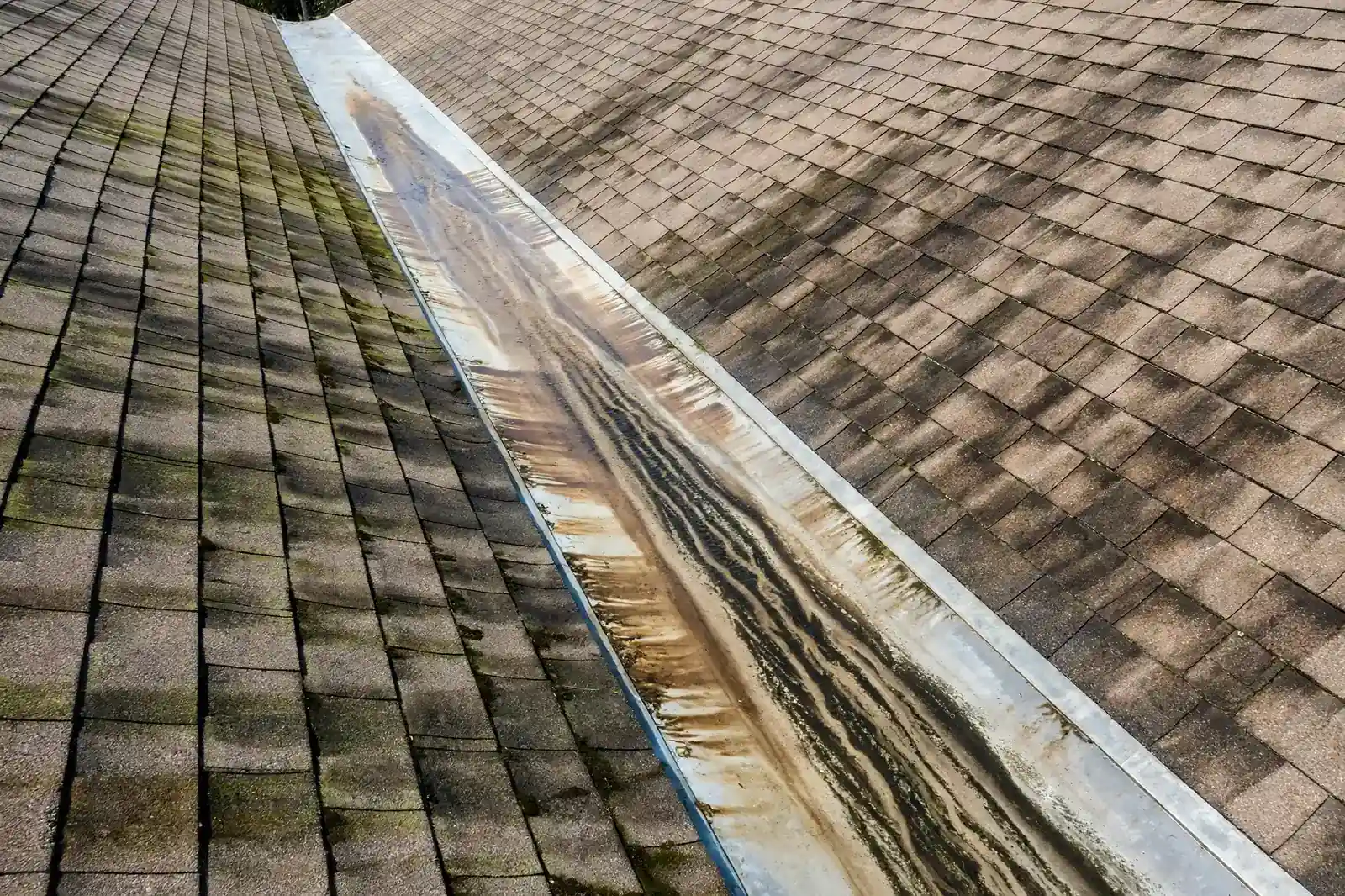
The attic above and around the signs is inspected for trails, staining, active damp, and insulation state, and moisture readings map the wet extent beyond what eyes can see. The survey works uphill from the indoor sign toward candidate entries, narrowing the roof area above from a whole slope to a shortlist of details, ridge, boot, valley, flashing, seam, in order of fit with the evidence.
Surface inspection of candidates
On the roof, the shortlisted details are examined closely, lifted and probed where their construction hides the failure, and their condition is matched against the attic map. Many leaks are located conclusively at this stage, a split boot exactly at the head of a damp trail needs no further proof. The inspection also grades neighbouring details, because a located entry often has ageing company.
Staged water testing
Where inspection alone cannot convict, water is applied to one candidate area at a time, low to high, with an observer at the interior sign, until a test reproduces the leak. That reproduction is the gold standard of detection, it converts suspicion into a located, repairable fact. The visit ends with the entry named, the repair scoped to it, and verification by the next real rain arranged.
In Detail
What should you expect detection to cost versus repeated guessing?
Set a detection visit against the local arithmetic of the alternative. Each guessed repair carries a callout, materials, and labour, and in Beaumont it is usually followed, one storm later, by the same stain and another guess at a new location. Two cycles of that commonly exceed the price of one methodical detection, and they leave the entry still open and the decking a season wetter. Detection is not an added luxury on a difficult leak, it is the point where spending switches from renting hope to buying the answer the repairs needed from the start.
There is a limit to state honestly. A minority of leaks, deeply intermittent ones dependent on rare wind angles, or entries hidden inside inaccessible construction, can resist even staged testing on a given day. A good detection service tells you when it has reached strong probability rather than proof, scopes the repair to the most evidenced candidate first, and structures verification so the next storm completes the diagnosis. That honesty, located, probable, or unresolved, with the evidence for each, is the actual product. Beware any service that reports certainty on every leak it meets.
Local Conditions
How does Beaumont weather drive roof leak detection?
For roof leak detection, Beaumont's climate is not background detail, it is the cause behind most calls. Hurricane Harvey in 2017 stalled over Southeast Texas and caused severe flooding across the Beaumont area, flooding thousands of homes, while a United States rainfall record of 60.58 inches was recorded at nearby Nederland. Beaumont housing spans oil boom era historic homes from the early 1900s in and around the Oaks Historic District, mid century ranch and bungalow housing across South Park, Pear Orchard and the North End, and late twentieth century tract subdivisions on the west side in areas such as Dowlen West, Amelia and Calder Highlands.
['Lamar University', 'Neches River, along the east side of the city', 'Interstate 10, crossing Beaumont east to west', 'Dowlen Road retail corridor, including Parkdale Mall', 'Spindletop, site of the 1901 oil gusher, marked by the Spindletop Gladys City Boomtown Museum', 'McFaddin Ward House Museum on the Calder Avenue corridor', 'Texas Energy Museum in downtown Beaumont', 'Tyrrell Park and the Beaumont Botanical Gardens and Cattail Marsh area in the southwest of the city'] Beaumont has a humid subtropical climate in the Piney Woods region of eastern Texas and is among the wettest parts of the state, with annual rainfall around 60 inches in published climate summaries. A contractor who works in Beaumont reads that weather history in the roof itself, which is why local experience matters for roof leak detection.
Hurricanes and tropical storms are a recurring fact of life on this part of the Gulf Coast. Tropical Storm Imelda in 2019 also caused historic flooding in the city. None of that makes roof leak detection unusual work in Beaumont. It makes it routine work, done by contractors who see the same Gulf weather patterns on roofs across the city every week.
Cost Factors
What does roof leak detection cost in Beaumont?
Detection is priced as the diagnostic visit and any testing it needs, with the repair itself scoped separately once the entry is known. These rows show typical Beaumont figures.
Ranges are general guidance, not a quote. The contractor confirms the final price after inspecting your roof.
When To Call
When is a detection visit the right call in Beaumont?
Book detection when a leak has survived one honest repair attempt, when it appears only in certain storms, when stains show in places with no obvious roof feature above them, or when several spots mark in the same season. Those are the signatures of a leak whose entry has not been found, and another repair without detection is statistically a donation to the same misunderstanding. The first repair on a fresh, obvious fault needs no separate detection, the second attempt at the same stain always does.
Detection is also the right first call on a home new to you that comes with a leak story, after purchase, or when a flat section or much patched roof begins leaking and its history is unknown. Starting with the map, entries, moisture extent, past repair quality, converts an inherited mystery into a maintained roof with a file. In Beaumont, where rain will audit every conclusion within weeks, a detected and verified repair is the only kind that stays bought.
Go Deeper
Where does roof leak detection go from here?
City Page
Roof Leak Detection in Beaumont, TX
The local service page for roof leak detection across Beaumont, with first steps, response and coverage.
Open the city page →Neighbourhood
Roof Leak Detection in The Avenues
How roof leak detection plays out in The Avenues, with the problems local homes see most.
Roof Leak Detection in The Avenues →Cost Guide
Roof Repair Cost
Typical Beaumont price ranges for this kind of repair and what moves the price.
Read the cost guide →Roof Leak Detection by neighbourhood
The Roof Leak Detection in Beaumont, TX city page covers the whole city. Each neighbourhood page below looks at roof leak detection on its own streets, with its own housing and exposure.
FAQ
Roof Leak Detection questions, answered
A straightforward trace, attic survey plus a clear candidate found on inspection, fits in a single visit of an hour or two. Staged water testing for intermittent leaks takes longer and occasionally needs a return in suitable conditions, because the test must reproduce the storm behaviour, not just wet the roof.
You will be told which kind of case yours is as the evidence develops. Time spent staging tests is not padding, it is the difference between a located entry and a fourth confident guess with a hose.
Usually, yes, by reproducing its conditions rather than waiting for them. Directed water at the suspect lap, seam, or flashing, at the angle and volume the rare storm delivers, with an observer inside, triggers most intermittent entries on demand.
Where even that fails, the evidence still narrows the field to a graded shortlist, and a repair sequence starting with the strongest candidate, verified by the next natural event, is a rational plan. You should receive that shortlist and its reasoning in writing.
The visit is the product, a located cause, and condensation located is a successful outcome, it ends roof repair spending on a problem the roof never had and points you to the ventilation or insulation fix that will actually cure the dripping.
Judge detection by whether the answer was evidenced, moisture patterns, timing, and test results you were shown. A service that finds only roof faults on every call, in a city with Beaumont humidity, is not detecting, it is selling.
The focused trace is the core, but a competent visit notes the general condition around the search area and flags other ageing details it passes, boots near splitting, seals at their limit. That wider note costs little and prevents next seasons leak from being a surprise twin of this one.
A full roof condition survey is a larger service and should be quoted as such if you want it. Do not let scope drift decide for you, agree whether this visit is a trace, a survey, or both, before it starts.
Talk to someone about your roof today
Describe the problem on one call and get connected with a local Beaumont roofing contractor.