Pillar Guide · Hail Damage Repair
Hail Damage Repair in Beaumont
Hail damage is easy to miss because a hail marked roof often does not leak at all, at first. This guide explains how hail injures shingles and metal in Beaumont, how it is verified, and which marks need repair.
The Problem
Why is hail damage so hard to judge from the ground?
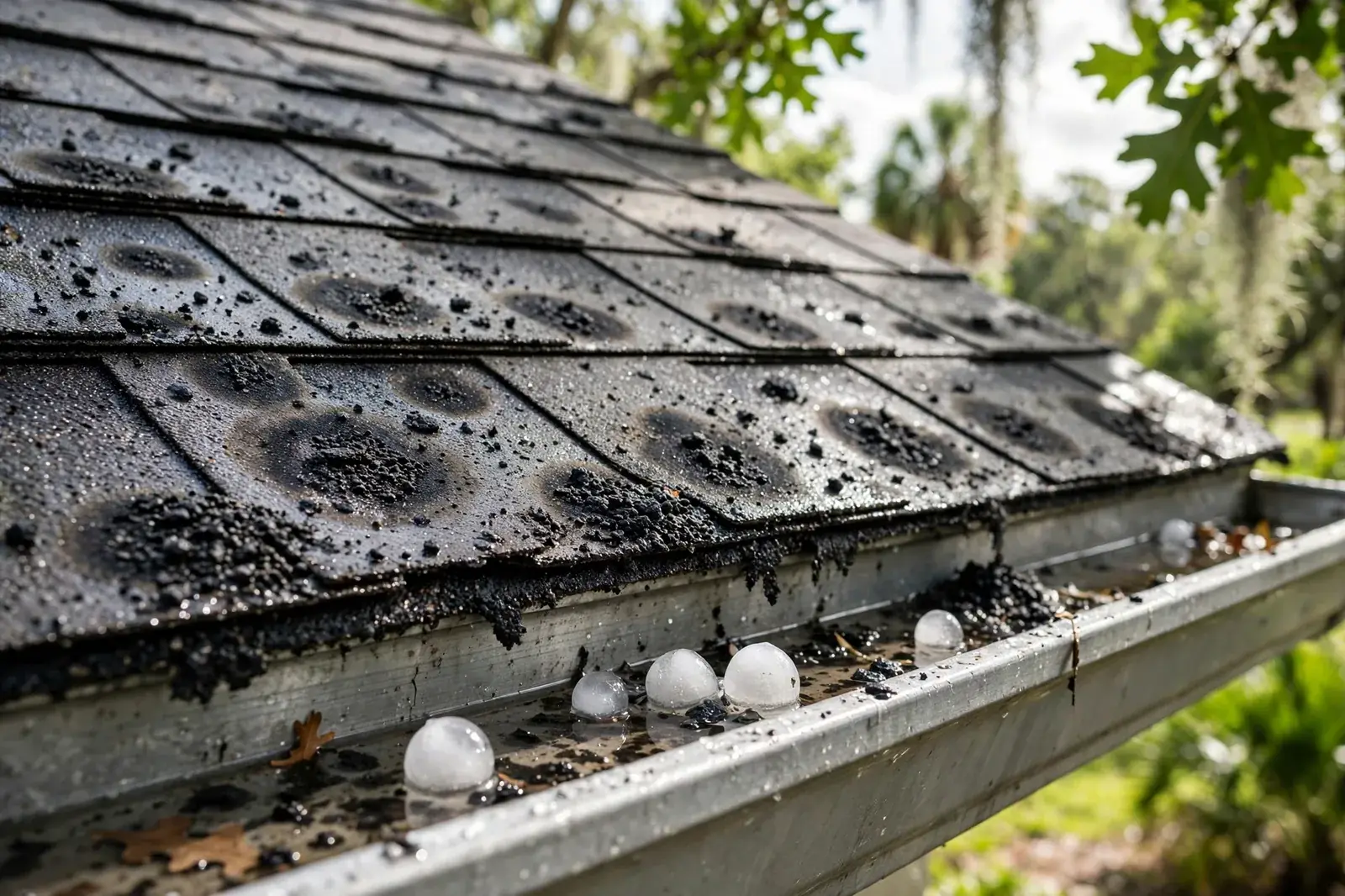
Hail injures a roof by bruising and fracturing the material where each stone lands, and almost none of that is visible from the yard. On shingles, the impact knocks granules loose and cracks the mat underneath, but the surface can look merely speckled. On metal, it leaves dents that may be cosmetic or may have split seams and coatings. Homeowners understandably look for holes and leaks, find neither, and conclude the storm did no harm, while the roof above them has lost years of working life in minutes.
The damage reveals itself slowly in Beaumont weather. Granules stripped by hail wash into gutters over the following weeks, and the exposed mat, baked by Gulf sun, turns brittle and starts to crack along the fracture lines the stones created. A roof that shed water perfectly in the month after the storm can begin leaking the next summer at points that map exactly to the heaviest impacts. That delay is why hail assessment has a window, close enough to the event to read the marks clearly and connect them to the storm.
Judging hail work also means separating real damage from lookalikes. Blistering, wear, and marks from foot traffic or debris can resemble hail hits, and honest assessment tells them apart by pattern, distribution, and what is found under the surface. Repairing every mark is wasteful, and dismissing genuine fractures is costly. The value of a hail inspection in Beaumont is that distinction, made on the roof with the material in hand, not from photographs of a ceiling that is not even leaking.
Causes
How does hail damage different parts of a Beaumont roof?
Hail does not strike a roof evenly or injure every material the same way. These are the damage forms a contractor checks for after a Beaumont hail event.
Fractured shingle mat
A hard impact cracks the fibreglass mat inside the shingle, even when the surface only shows a soft spot or a small granule scar. The fracture weakens with heat and flexing until it splits through. This is the core hail injury on asphalt roofs, and it is confirmed by feel and by checking the mat beneath the granule loss point.
Granule displacement
Each strike knocks the protective granule layer loose at the impact point, and rain then washes more granules from the weakened area. Exposed asphalt ages rapidly in Gulf sun, drying and curling at the scar. Heavy granule flow in gutters after a storm is often the clearest ground level evidence that the surface took real hail harm.
Bruised and softened spots
Some impacts crush the shingle layers without a clean fracture, leaving a spongy spot that compresses under finger pressure. Bruised areas hold water, wear faster than the surrounding surface, and eventually open. They are easy to miss in a visual scan and are found by methodically working the slope by hand during a proper hail inspection.
Dented and split metal panels
On metal roofing, hail dents panels and can split seams, crack coatings, and loosen clips where the metal flexed. Shallow dents may be purely cosmetic, but coating cracks invite corrosion in Beaumont humidity, and seam damage lets wind driven rain in. Each panel type responds differently, so assessment has to be specific to the system fitted.
Damaged vents, caps and soft metals
Ridge caps, vent covers, and flashing metal show hail strikes more clearly than shingles do, and contractors read them as indicators of stone size and intensity across the roof. Crushed vent caps and dented caps also need repair in their own right, since they sit at points where water concentrates and entry is easy once the cover is deformed.
Cracked skylight and flashing seals
Hail can crack skylight glazing and domes and break the seals around flashing and curb details through repeated impact vibration. These junction failures may leak immediately, unlike shingle fractures. After a hail event, a leak at a skylight or chimney is often hail related even when the main surface damage is of the slow, hidden kind.
The Process
How is hail damage assessed and repaired?
Record the storm and mark test areas
The contractor notes the storm date and works defined test squares on each slope, marking and photographing impacts to establish the pattern and density of damage. Random, evenly distributed marks in a test area point to hail, while clustered marks in one spot suggest another cause. This method is what separates an assessment from an opinion.
Check the mat and the soft metals
Marked shingles are examined for fractures and bruising beneath the surface, and vents, caps, and flashing are read for the size and force of the stones. The attic is checked too, since hail events travel with heavy rain that may have entered at displaced details. Together these checks grade the damage honestly by area.
Agree repair by slope and severity
Fractured and bruised shingles are replaced unit by unit where damage is scattered, and by section where a slope is heavily hit. Damaged caps, vents, and seals are renewed as individual items. You receive a scope tied to the marked evidence, so you can see exactly which findings each part of the price answers.
Replace and blend the repairs
New shingles are woven into the existing courses so laps and water flow stay correct, and a close colour match is chosen, with the understanding that new material weathers in over time. Metal and detail repairs are sealed and refixed to their original pattern. The finished work is checked slope by slope against the original damage record.
In Detail
What is the difference between cosmetic hail marks and functional damage?
Functional damage shortens the life of the roof or lets water in, fractured mats, bruised shingles, split seams, cracked coatings. Cosmetic damage changes appearance only, shallow metal dents with intact coating, or light granule scuffing within normal wear. The distinction matters in Beaumont because both look dramatic after a storm, and homeowners are pressured in both directions, told everything is ruined or that nothing matters. A test square assessment, with the mat checked by hand, is the practical way to sort one from the other on your own roof.
There is also a timing point. Hail fractures do not heal, and the Gulf climate works on them steadily, sun baking the exposed mat, rain washing the scars wider, wind flexing the weakened shingles. A slope judged borderline in spring can be clearly failing by the following summer. That does not mean every hail marked roof needs immediate section work, it means the findings should be recorded with dates and photos while they are fresh, so change over time can be shown rather than argued about later.
Local Conditions
How does Beaumont weather drive hail damage repair?
For hail damage repair, Beaumont's climate is not background detail, it is the cause behind most calls. Hurricane Rita in 2005 and Hurricane Ike in 2008 both caused significant damage in the area. Hurricane Laura in 2020 was forecast to strike near the Texas and Louisiana border but turned east, sparing Beaumont its worst impacts, with a recorded gust of 74 miles per hour at Beaumont Municipal Airport, and Hurricane Delta weeks later brought gusts to 90 miles per hour at Jack Brooks Regional Airport and felled trees across the area.
['architectural asphalt shingle, the most common covering on Beaumont homes', 'composition and three tab asphalt shingle, still found on older and smaller homes', 'standing seam and panel metal, increasingly used as a storm resistant replacement, with at least one documented metal roof on an Amelia area home', 'cedar shake and clay tile, present on a minority of historic era homes, including a documented terra cotta tile roof in the neighbouring Caldwood addition'] Those conditions shorten shingle life compared with drier parts of Texas, make flashing and ventilation details critical, and mean roof deck rot is a common finding when older roofs in the city's mid century neighbourhoods are torn off. A contractor who works in Beaumont reads that weather history in the roof itself, which is why local experience matters for hail damage repair.
Atlantic hurricane season runs from June 1 through November 30. Hurricane Harvey in 2017 stalled over Southeast Texas and caused severe flooding across the Beaumont area, flooding thousands of homes, while a United States rainfall record of 60.58 inches was recorded at nearby Nederland. None of that makes hail damage repair unusual work in Beaumont. It makes it routine work, done by contractors who see the same Gulf weather patterns on roofs across the city every week.
Cost Factors
What does hail damage repair cost in Beaumont?
Hail repair pricing follows how many units and details were functionally damaged, not how loud the storm sounded. These rows cover the typical Beaumont hail repairs.
Ranges are general guidance, not a quote. The contractor confirms the final price after inspecting your roof.
When To Call
When should you have hail damage checked in Beaumont?
Arrange a check after any storm that drops stones large enough to dent car metal, damage garden furniture, or strip leaves heavily in your area. Those ground level signs correlate with roof level force worth assessing. You do not need a leak to justify the call, with hail the absence of leaking is normal even on a genuinely damaged roof, and waiting for one means waiting until the fractures have aged into failures.
Call promptly rather than next season, because the evidence is freshest soon after the event and any claim process you pursue will ask when the damage occurred. A dated inspection record made within a short time of the storm is far more useful than a first look taken months later, when wear and hail harm have blended together and neither can be stated with confidence.
Go Deeper
Where does hail damage repair go from here?
City Page
Hail Damage Repair in Beaumont, TX
The local service page for hail damage repair across Beaumont, with first steps, response and coverage.
Open the city page →Neighbourhood
Hail Damage Repair in South Park
How hail damage repair plays out in South Park, with the problems local homes see most.
Hail Damage Repair in South Park →Cost Guide
Roof Repair Cost
Typical Beaumont price ranges for this kind of repair and what moves the price.
Read the cost guide →Hail Damage Repair by neighbourhood
The Hail Damage Repair in Beaumont, TX city page covers the whole city. Each neighbourhood page below looks at hail damage repair on its own streets, with its own housing and exposure.
FAQ
Hail Damage Repair questions, answered
Fractured and bruised shingles will not recover, but they rarely demand same week work unless rain is entering at damaged details. The usual right move is a prompt assessment, a recorded scope, and repairs scheduled in order of severity.
What should not wait is the inspection itself. Evidence fades, granules wash away, and later wear confuses the picture, so the assessment is time sensitive even when the repair is not.
Yes, where damage is scattered, individual units can be lifted and replaced, weaving the new shingle into the surrounding courses. On older, brittle roofs the neighbouring shingles may crack during the work, which the contractor should flag before starting.
Where a test square shows dense functional damage across a slope, section replacement is usually the more honest scope. Replacing dozens of single units in a field of weakened shingles rarely holds together as a durable result.
Hail marks are random in pattern, appear across slopes and on soft metals at the same time, and date from one event. Wear is gradual, worst on the sunniest slopes, and shows as general thinning rather than distinct impact points.
That said, certainty needs a roof level check with the mat examined by hand. Ground level guessing in either direction, panic or dismissal, is how homeowners end up with the wrong scope.
Shallow dents with intact seams and coating usually do not leak and may need no repair beyond monitoring. Hail becomes a leak risk on metal when seams split, clips loosen, or coating cracks and corrosion begins in the humid air.
A metal specific inspection checks those three points rather than counting dents. The number of dents matters far less than their depth at seams and the condition of the coating afterwards.
Talk to someone about your roof today
Describe the problem on one call and get connected with a local Beaumont roofing contractor.