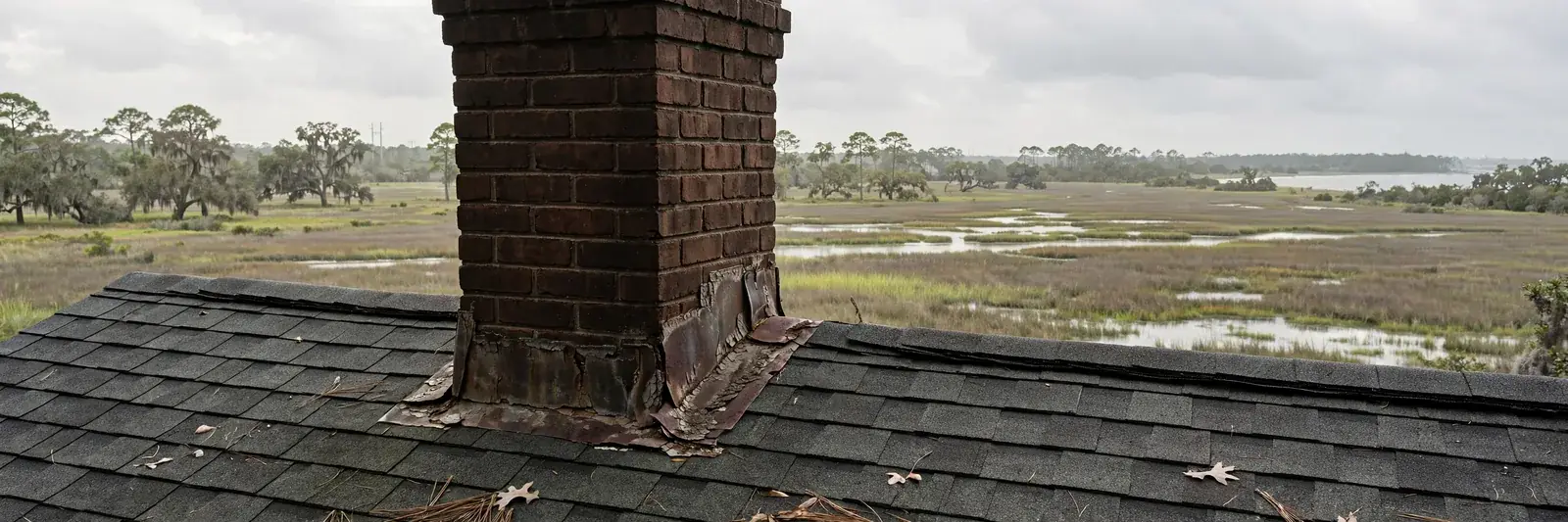
Pillar Guide · Chimney Flashing Repair
Chimney Flashing Repair in Beaumont
The chimney is the largest hole in most roofs, and its flashing is a small system of metal, mortar, and a water shedding saddle. This guide explains how chimney flashing fails in Beaumont and how the joint is rebuilt to stay dry.
The Problem
Why do chimneys leak so often in Beaumont homes?
A chimney interrupts the roof with four different joints at once, uphill, downhill, and two sides, each shedding water differently, and the masonry itself absorbs and releases moisture in a way no other roof junction does. Flashing a chimney properly takes several components working together, base flashing woven with the shingles, step flashing up the sides, counter flashing cut into the mortar joints, and a saddle behind the chimney to split the water arriving from the slope above. When any one component fails, the system leaks, and Beaumont rain finds the weakness thoroughly.
The uphill side is where the trouble concentrates. Water running down the slope meets the back of the chimney and must be diverted around it, and on wider chimneys that collected volume overwhelms a flat or poorly shaped saddle, especially when leaves and debris lodge behind the stack. From inside, the leak then appears around the fireplace or on the ceiling beside it, and homeowners understandably blame the chimney masonry or the cap. Sometimes the masonry is involved, cracked mortar and porous brick do admit water, but the flashing system below is the first suspect a Beaumont contractor tests.
Age attacks every part of the chimney joint at once in this climate. Mortar softens and the counter flashing chase loosens, metal corrodes in the damp crevice where it meets masonry, sealants bake and part, and the saddle fills with silt. A chimney that was dry for decades can begin leaking at several points in the same few seasons, not from one dramatic failure but from the whole system reaching its limit together. That is why chimney flashing repair here is usually a renewal of the joint as a system, rather than a hunt for a single hole.
Causes
What fails in chimney flashing in Beaumont?
Chimney leaks come from specific components of the joint, each with its own failure pattern in Gulf weather. A proper inspection reports on each of these separately.
Counter flashing loose in its mortar chase
Counter flashing is tucked or cut into a mortar joint and covers the top edge of the flashing below. As mortar ages, cracks, and washes out, the metal works loose and rain runs behind it straight into the joint. Surface applied counter flashing, stuck to the brick face with sealant, fails the same way sooner. This is the single most common chimney leak cause found in Beaumont inspections.
Step flashing failure at the sides
The sides of the chimney are waterproofed by small metal pieces stepped up with each shingle course. If they corrode, are fitted as one long piece instead, or their overlaps are disturbed, driven rain enters at the side joints. Side leaks often present as staining down the chimney breast indoors, and they worsen in storms that drive rain against that particular face.
Saddle or cricket blockage and failure
The small pitched structure behind the chimney that splits uphill water, the saddle or cricket, collects debris, silt, and leaves in Beaumont conditions, and its own flashing and covering age like any roof detail. A blocked or failed saddle ponds water against the back of the stack, the worst place on the whole joint to hold water, and leaks there can be heavy in a downpour.
Corroded or split flashing metal
Chimney flashing lives in a damp crevice and is attacked by mortar contact, standing debris moisture, and plain humid air. Galvanised pieces eventually rust through at bends and fixings, sometimes while the visible face still looks serviceable. Only easing the shingles and inspecting the buried pieces reveals through corrosion, which is why chimney quotes given without exposure are unreliable.
Cracked mortar, crown and masonry
Not every chimney leak is flashing. The concrete crown on top cracks, mortar joints open, and porous brick and flue joints can admit wind driven rain that travels down inside the stack and emerges at the roofline, mimicking a flashing leak. A thorough chimney assessment separates masonry water from flashing water, because the trades and the remedies differ and fixing one will not cure the other.
Sealant dependent repairs from the past
Chimneys attract repeated surface sealing more than any other joint, beads and coatings layered over the counter flashing line and the saddle. Each layer holds for a shorter time than the last, and the build up can dam water into the joint. Many Beaumont chimney repairs begin by removing years of this material to reach the metal and masonry that should have been renewed at the first attempt.
The Process
How is chimney flashing rebuilt properly?
Separate flashing water from masonry water
The contractor inspects the crown, mortar, and masonry above the roofline as well as the flashing below it, and uses the leak pattern and, where needed, staged water testing to locate the entry system. This separation decides whether the job is roofing, masonry, or a sequence of both, and it prevents the common local waste of reflashing a chimney whose crown is the real entry.
Strip the joint to sound material
Shingles around the base are lifted, old flashing and accumulated sealant are removed, and the chase in the mortar joint is cleaned out. Decking and the top of the roof structure at the joint are checked for water damage and repaired if softened. The chimney joint is one place where preparation is plainly half the job, and it should be visible in the time the work takes.
Fit the full flashing system
New base and step flashing are fitted in layers with the shingles, the saddle behind the chimney is rebuilt or renewed with its covering, and counter flashing is cut into the mortar joint and pointed in properly, not glued to the face. Each piece is set in the order water will meet it, and the downhill side is finished to discharge cleanly onto the slope below.
Test and advise on the masonry
The rebuilt joint is water tested where practical, and you are shown the finished detail and told plainly about the condition of crown, mortar, and brick above the flashing line. If masonry work is needed, it is identified as a separate item with its own trade, so the roof joint is not blamed later for water entering above it.
In Detail
What role does the chimney saddle play in leaks?
The saddle, also called a cricket, is the small roof built behind the chimney to divide the flow arriving from the slope above and send it around the sides. On a narrow chimney a simple flashing diversion may cope, on a wide chimney the volume collected is large, and in Beaumont rain it arrives fast and carrying debris. A saddle that is undersized, flat, or covered in failed material ponds that water against the back flashing, and the joint is then tested by a pool rather than a stream, a test aged seals and corroded metal reliably fail.
Keeping the saddle clear is the owners part of the bargain. Leaves and silt settle behind chimneys here after every storm season, and that dam does the ponding even when the saddle shape is good. If you can see debris banked behind your chimney from the ground or an upstairs window, it is worth having it cleared and the saddle covering checked at the same visit. It is a small, unglamorous piece of maintenance that protects the most leak prone joint on the entire roof.
Local Conditions
How does Beaumont weather drive chimney flashing repair?
For chimney flashing repair, Beaumont's climate is not background detail, it is the cause behind most calls. For roofs, the Beaumont combination that matters is high annual rainfall, sustained humidity, algae friendly shade, and periodic hurricane wind and wind driven rain. Summers are long, hot and humid, and the wet season runs roughly from April to October.
Hurricane Rita in 2005 and Hurricane Ike in 2008 both caused significant damage in the area. Hurricane Laura in 2020 was forecast to strike near the Texas and Louisiana border but turned east, sparing Beaumont its worst impacts, with a recorded gust of 74 miles per hour at Beaumont Municipal Airport, and Hurricane Delta weeks later brought gusts to 90 miles per hour at Jack Brooks Regional Airport and felled trees across the area. A contractor who works in Beaumont reads that weather history in the roof itself, which is why local experience matters for chimney flashing repair.
['architectural asphalt shingle, the most common covering on Beaumont homes', 'composition and three tab asphalt shingle, still found on older and smaller homes', 'standing seam and panel metal, increasingly used as a storm resistant replacement, with at least one documented metal roof on an Amelia area home', 'cedar shake and clay tile, present on a minority of historic era homes, including a documented terra cotta tile roof in the neighbouring Caldwood addition'] Those conditions shorten shingle life compared with drier parts of Texas, make flashing and ventilation details critical, and mean roof deck rot is a common finding when older roofs in the city's mid century neighbourhoods are torn off. None of that makes chimney flashing repair unusual work in Beaumont. It makes it routine work, done by contractors who see the same Gulf weather patterns on roofs across the city every week.
Cost Factors
What does chimney flashing repair cost in Beaumont?
Chimney work is priced by the size of the stack, roof access, and whether the full system or one component needs renewal. These rows cover the usual Beaumont cases.
Ranges are general guidance, not a quote. The contractor confirms the final price after inspecting your roof.
When To Call
When should chimney flashing be looked at in Beaumont?
Call when staining appears around the fireplace, on the wall beside the chimney, or on the ceiling near it, when mortar fragments or rust appear at the base of the stack, or when a leak tracks storm direction. Chimney joints in Beaumont sit inside the wall construction once water passes them, so the hidden damage, timber, plaster, flue surroundings, grows while the visible stain stays modest. Early renewal of the joint is far cheaper than the combined roofing and interior bill later.
A chimney check belongs in the preparation for storm season on any older Beaumont home, and after any event that dropped debris on the roof. The saddle cleared, counter flashing sound in its chase, and step flashing intact is a chimney that can take driven rain. Those three items can be graded in one short visit, and dealing with them in calm weather is the difference between a maintained joint and a recurring emergency at the same fireplace.
Go Deeper
Where does chimney flashing repair go from here?
City Page
Chimney Flashing Repair in Beaumont, TX
The local service page for chimney flashing repair across Beaumont, with first steps, response and coverage.
Open the city page →Neighbourhood
Chimney Flashing Repair in Dowlen West
How chimney flashing repair plays out in Dowlen West, with the problems local homes see most.
Chimney Flashing Repair in Dowlen West →Cost Guide
Roof Repair Cost
Typical Beaumont price ranges for this kind of repair and what moves the price.
Read the cost guide →Chimney Flashing Repair by neighbourhood
The Chimney Flashing Repair in Beaumont, TX city page covers the whole city. Each neighbourhood page below looks at chimney flashing repair on its own streets, with its own housing and exposure.
FAQ
Chimney Flashing Repair questions, answered
It can be either, or both, and the pattern gives clues, flashing leaks usually follow rain promptly and map to one face or the base, while masonry entry through a cracked crown or open joints often lags and can damp the breast more widely. Staged testing settles it.
Expect a proper assessment to inspect above the roofline as carefully as below it. A contractor who only looks at the flashing, or only blames the brickwork, without testing, is giving you half a diagnosis on the joint that needs a whole one.
Sealing the visible line may slow a leak for a season if the metal beneath is sound, but it cannot renew corroded step flashing, refit a loose counter flashing chase, or rebuild a saddle. Those are the actual failures in most Beaumont chimney cases.
Treat any sealant work at a chimney as a holding measure with a date on it, and budget for the system renewal it is postponing. The joint will collect the full price eventually, with interest in the form of internal damage if the holding measure is mistaken for a repair.
On wider chimneys, a saddle is the difference between water flowing around the stack and water ponding behind it. If your chimney is wide, has no saddle, and leaks at its back in heavy rain, adding a properly flashed saddle is often the core of the cure rather than an optional extra.
Narrow chimneys on steeper slopes may genuinely not need one. The contractor should explain the judgement from the width, the slope, and where your leak water actually gathers, not from a blanket rule.
Crown and mortar work is masonry, flashing is roofing, and a leaking chimney can need both in sequence. A roofing contractor will identify masonry faults found during flashing work and tell you plainly that they sit outside the flashing scope.
What matters is that the two are not confused on the invoice. Flashing renewal priced and done properly, masonry faults named separately, gives you a joint where any future leak can be attributed correctly instead of argued over.
Talk to someone about your roof today
Describe the problem on one call and get connected with a local Beaumont roofing contractor.