Homeowner Guide
Does Insurance Cover Roof Repairs in Beaumont?
Whether insurance helps with a roof repair is one of the most misunderstood questions in Beaumont, especially in the days after a Gulf storm. This guide explains, in general terms only, the kinds of damage policies are usually written around, the kinds they usually are not, and why documentation decides so much of the outcome. It also sets out what to do first after storm damage and the questions worth putting to your insurer.
Guide
What kind of damage may be covered?
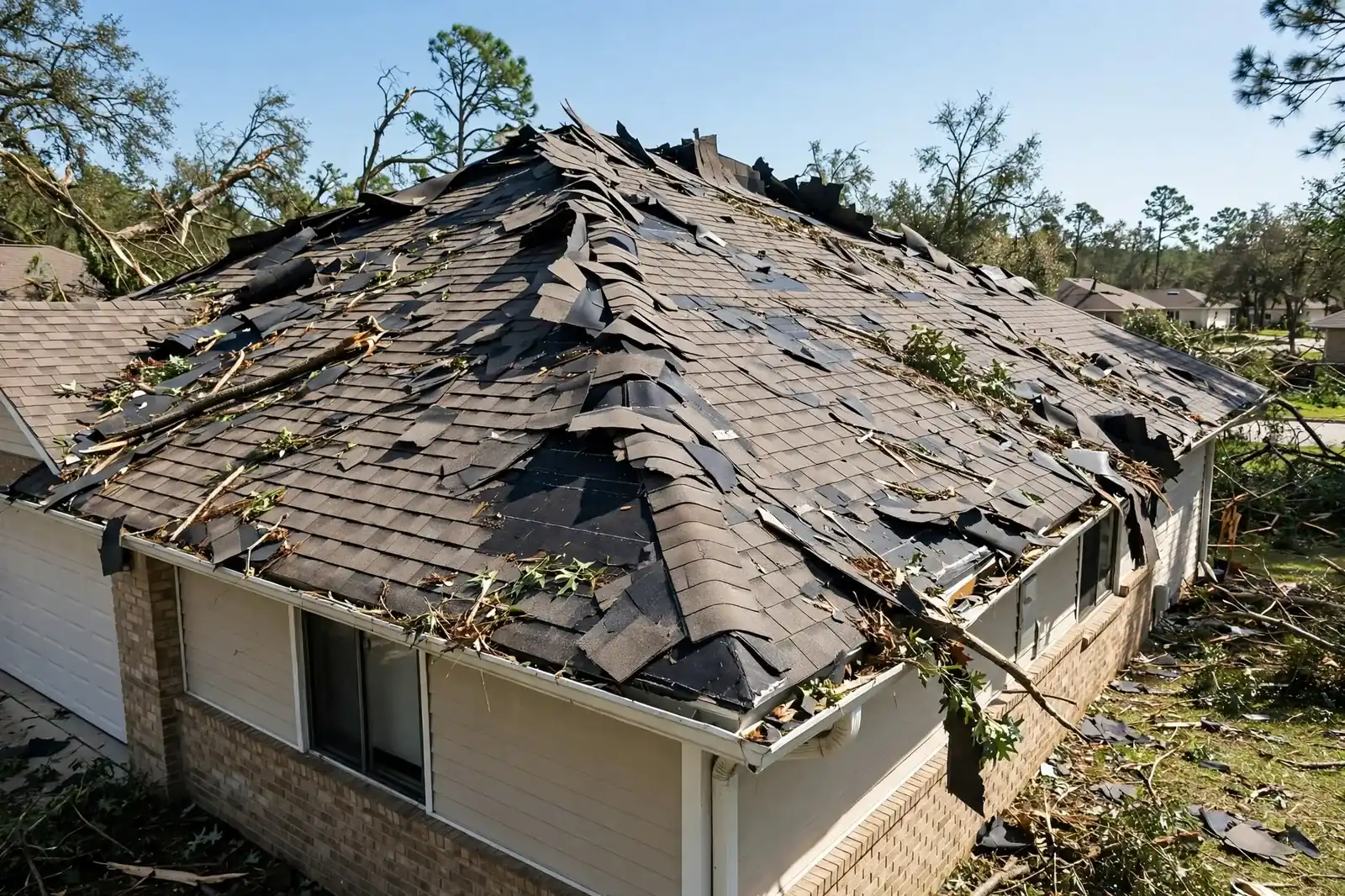
Insurance cover for roof repairs turns on what caused the damage, and the clearest cases involve a sudden event. Wind tearing shingles away during a Gulf storm, debris driven into the surface, or a tree limb falling onto the roof are the kinds of events home policies are generally written to respond to. Policies vary in their wording, limits, and conditions, so this guide can only describe the general shape of cover, never the position of your own policy. The detail of your documents, read alongside the facts of the damage, is what decides any individual claim.
Sudden damage usually leaves evidence that ties it to a date. A roof that was keeping water out before a named storm and leaking straight after it, with lifted or missing surface matching the wind that passed, presents a clear story. Damage spread evenly by age across every slope tells a different one. Insurers look for that connection between an event and a change in the roof, which is why the timing of when you first noticed a problem matters almost as much as the problem itself. Photographs taken soon after the event carry that connection better than any later reconstruction. Keeping that date connection intact is the main reason the documentation section of this guide matters so much.
Guide
What kind of damage is often not covered?
Damage that arrives slowly, through wear and age, is the kind most often outside cover. Rubber collars that crack after years of sun, sealant that has hardened and split gradually, flashing that has corroded over seasons, and shingles that have simply worn thin are maintenance matters in the eyes of most policies. A slow leak that has built up over months, staining a little more with each rain, usually falls into the same category, because its cause is deterioration rather than an event. That position surprises many homeowners, which is exactly why understanding it early helps you plan the repair on the right basis.
Damage that began before a policy started, or an old problem left to worsen, creates difficulties of a different kind. If a roof shows long standing damp in the decking alongside fresh storm damage, an insurer may look to separate the two and respond only to the part the event caused. An honest contractor description helps here rather than hinders, because clear findings about which area is old and which is new give everyone a fair basis. Leaving a known problem unrecorded and unrepaired for a long stretch is the pattern most likely to complicate a later claim, so early attention protects both the roof and your position.
Guide
How does documentation help a claim?
Good documentation turns a claim from an argument about memory into a reading of evidence. Dated photographs of the roof damage and of any stain inside, a note of the storm date and of when you first noticed the problem, and invoices for any protective work together build the timeline an insurer needs. In Beaumont, where a wet season can blur one storm into another, that timeline is often the difference between damage that can be tied to an event and damage that cannot. Start the record on the first day, because details that feel unforgettable in the week of a storm fade quickly.
The written findings from the contractor form the other half of the record. A clear description of the entry point, the likely cause, and the condition of the surrounding surface, supported by photographs taken on the roof, gives your insurer something concrete to assess. The roles are worth keeping straight: the contractor describes the damage and prices the repair, and the insurer decides the claim under your policy. Findings written honestly, including anything that points to wear rather than the storm, carry more weight than findings written to please, because they can be trusted as a whole.
Guide
What should you do right after storm damage?
The first hours after a Gulf storm should go on safety and limiting harm. Check whether water is entering, move belongings and coverings out of its path, and place a container under any drip, keeping clear of any ceiling that looks heavy or sagging with water. Photograph the damage inside and, from the ground, outside, before tidying where you safely can, because those early images capture the scene as the storm left it. If a fallen limb or debris is involved, photograph that too before it is moved, since its position forms part of the story of what happened. If water is reaching a fitting or socket, keep everyone away from it until the area is dry.
Protective work comes next, because policies commonly expect a homeowner to take reasonable steps to stop further damage once it is safe to do so. Emergency roof tarping at $200 to $550 as general guidance covers securing the damaged area so the next band of rain stays outside while the claim and the lasting repair are arranged. Keep the tarping invoice with your photographs, since it shows both the step taken and its cost. Avoid starting lasting repairs that change the damaged area before your insurer has had a chance to see it, unless waiting would plainly let serious further harm happen.
Guide
How do repairs and claims fit together?
The practical sequence runs in a sensible order: protect the home, document the damage, open the claim, have the roof inspected, and then agree the repair scope with full knowledge of where each decision sits. Lasting repairs can then proceed in line with whatever your insurer has told you, with the damaged area documented before it is opened. Some homeowners, faced with a small repair, choose to pay directly and keep the claim out of it, and that judgement depends on the figures and their own policy terms. Either route works better with the same written findings behind it. Keeping each step in that order prevents the common tangle of work done before anyone recorded the damage.
Repair pricing and claim decisions are separate matters, and keeping them separate avoids confusion. A contractor prices the work the roof actually needs: roof leak repair at $300 to $900, flashing repair at $275 to $800, or ceiling leak tracing and repair at $300 to $850, each general guidance confirmed after inspection. An insurer then decides what, if anything, the policy contributes toward that work. A claim outcome, favourable or not, does not change what the roof needs, and a repair properly scoped does not depend on guessing the outcome in advance. Written scope first, claim conversation second, is the order that keeps both honest.
The referral service behind this page has a distinct place in that sequence. Beaumont Roof Repair TX connects homeowners with local roofing contractors, and those contractors inspect roofs and carry out repairs; the service itself does not do the work, and neither it nor the contractor decides your claim. That decision rests with your insurer under your policy wording. If a claim does not succeed, the repair need usually remains, and a written scope lets you proceed in planned stages if that suits your budget, starting with whatever keeps the home dry.
Guide
What questions should you ask your insurer?
Begin with the questions that frame the whole claim. Ask whether the kind of damage your roof has suffered falls within your policy terms, what evidence the insurer needs from you, what amount you are expected to meet yourself first, and whether they want to see the damage before any lasting repair begins. Ask how protective work, such as tarping already carried out, should be recorded and submitted. Each answer shapes a practical decision, so write the answers down with the date of the conversation rather than trusting them to memory.
Follow with the questions about process and timing. Ask who will assess the damage and when, how long reporting storm damage can take before it becomes a problem under your policy, and what happens if opening the roof reveals further damage connected to the same event. If part of a claim is accepted and part is not, ask how that split is worked out and recorded. Homeowners in Beaumont often deal with these conversations in a busy post storm period, and a calm list of questions asked early prevents the small misunderstandings that later take weeks to unpick.
Keep Reading
What should you read next?
Related
Storm Damage Roof Repair
Continue with the related page on this site.
Storm Damage Roof Repair →Related
Storm Damage Roof Repair Cost
Continue with the related page on this site.
Storm Damage Roof Repair Cost →FAQ
Questions, answered
No. A storm passing is the beginning of the question, not the answer to it. Cover generally depends on whether that sudden event actually caused the damage, how your own policy is worded, and what the evidence shows about the condition of the roof before and after. Photograph any damage promptly, note the date, and put the question to your insurer with the findings from the contractor in hand, because those facts together are what the decision rests on.
It is worth one honest conversation, but go in with realistic expectations. Damage from wear, age, or a seal failing gradually is usually treated as maintenance rather than a sudden event, and many policies respond differently to the two. Whatever the answer, the leak still needs tracing and repair.
Yes, in most situations protective tarping is the right first step, because leaving an opening unprotected lets further damage happen that helps nobody. Emergency roof tarping at $200 to $550 as general guidance covers that protection, and keeping the invoice and photographs of the damage before and after shows exactly what was done and why. Lasting repairs that change the damaged area are the ones to pause on until your insurer has had its chance to look, unless waiting would cause serious further harm.
No, and you should be wary of anyone who says otherwise. The role of the contractor is to inspect the roof, describe the damage and its likely cause honestly in writing, and price the repair the roof needs. The claim decision belongs to your insurer, made against your policy wording and the documented facts. A contractor who keeps those roles clear, and writes findings that would stand up whichever way the decision goes, is giving you the most useful help available at that stage.
Have the date of the storm or of when you first noticed the problem, dated photographs of the damage inside and out, the written findings from the contractor with the traced entry point and likely cause, and any invoice for protective work already done. That bundle lets the conversation start from evidence, and it saves you reconstructing a timeline later from memory.
Talk to someone about your roof today
Describe the problem on one call and get connected with a local Beaumont roofing contractor.