Pillar Guide · Asphalt Shingle Repair
Asphalt Shingle Repair in Beaumont
Asphalt shingle repair is specific work on a specific material, with its own failure patterns, fixing rules, and limits. This guide goes deeper into the material itself for Beaumont homeowners whose roofs are showing wear, leaks, or storm marks.
The Problem
How do asphalt shingles break down in Beaumont conditions?
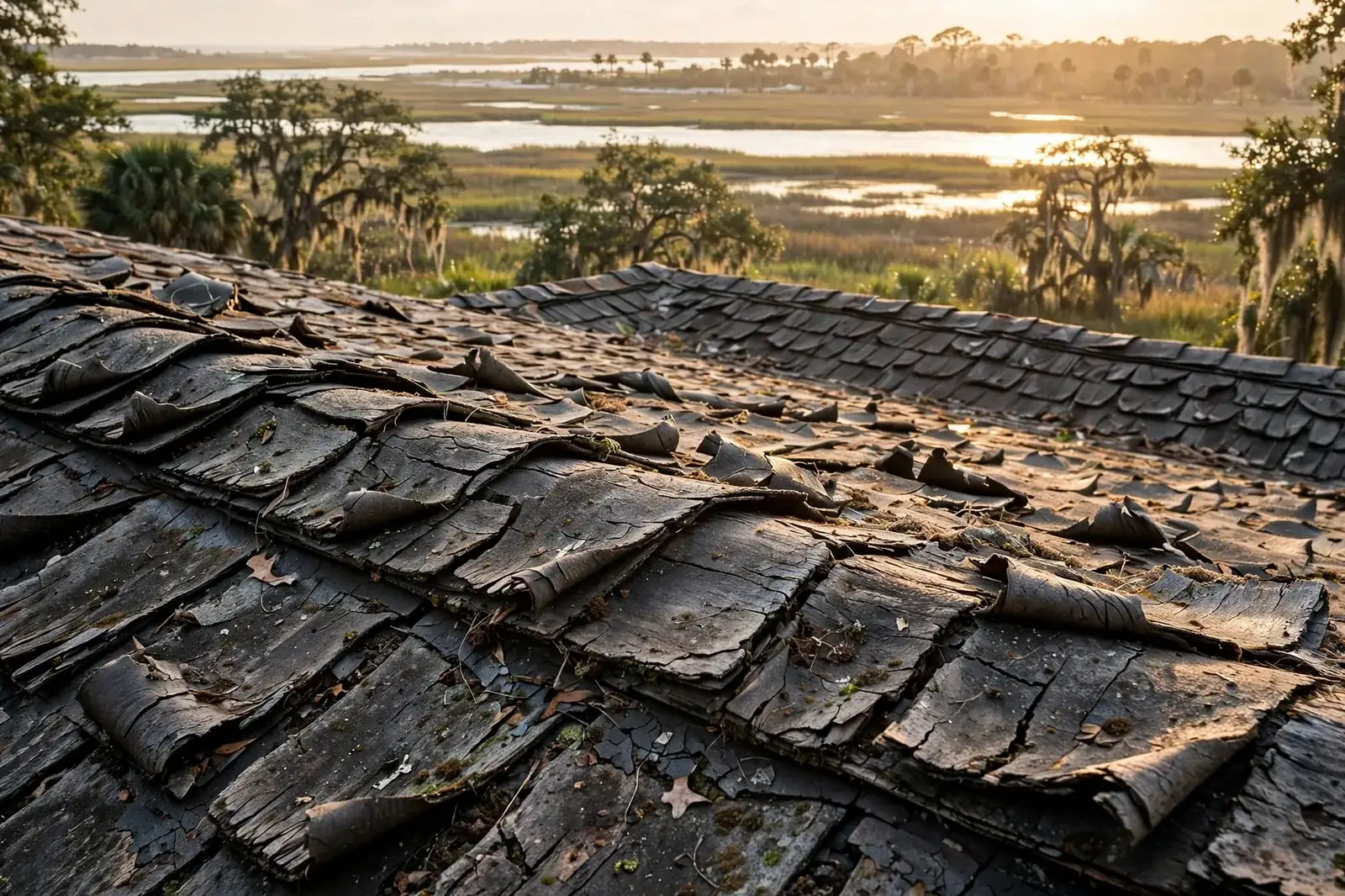
An asphalt shingle is a fibreglass mat saturated and coated with asphalt and surfaced with mineral granules, and each of those layers has its own enemy in Beaumont. Heat drives the lighter oils out of the asphalt, leaving it dry and prone to cracking. Ultraviolet light attacks any asphalt the granules no longer cover. Water in Beaumont volumes finds every crack and unsealed lap, and humidity keeps the whole assembly from ever fully drying, so decay that would pause in a dry climate here continues through most of the year.
The breakdown follows a recognisable order. Granule coverage thins first, then exposed areas craze and curl, bonds between courses weaken, and finally units crack through, slip, or blow away. A roof can spend a long time in the early stages looking serviceable from the street, which tempts owners to postpone attention. The cost curve runs the other way, work in the granule and bond stages is maintenance, work once units are cracking through and decking is taking water is rebuilding, with interior repairs queuing behind it.
Repairing asphalt shingles well means respecting how the material is made. New units must be the same type and thickness to sit flat in the field, fixings must land in the reinforced nail line and neither crush nor cut the mat, and seals must be compatible with the existing asphalt. Shortcuts with the wrong product, sealant smeared as a surface skin, nails through the exposed face, are visible on Beaumont roofs everywhere, and they fail in predictable ways that a material aware contractor will point out during your inspection.
Causes
What specifically fails in asphalt shingles?
Asphalt shingle failures are material failures, each with a distinct look and remedy. These are the ones a Beaumont contractor tests for when assessing a repair.
Asphalt drying and crazing
As the asphalt coating loses its oils to Gulf heat, the surface develops a network of fine cracks resembling dried mud. Crazed areas shed granules faster and split deeper with flexing. This is age and heat damage, not a defect in one unit, and where it is general across a slope it signals that the material itself is nearing the end of its workable life.
Mat fracture from impacts and flexing
Hail strikes and wind bending crack the fibreglass mat inside the shingle, sometimes without much surface sign. Fractured units feel soft or break when gently flexed, and the crack line widens until rain passes through. Mat fracture is the key test in both hail and wind assessment, because it separates units that look marked from units that are actually broken.
Granule erosion and bald spots
Granules detach through rain impact, foot traffic, debris scouring, and simple age, leaving smooth, dark, shiny patches of exposed asphalt. Those patches absorb more heat and degrade at a multiple of the protected rate around them. Bald spots near the end of their surrounding granule life usually mean the slope, not just the patch, needs a renewal conversation.
Bond strip failure
The factory adhesive strip that seals each course depends on heat and pressure to activate and on a clean surface to grip. Dust, age, and repeated thermal movement break it down until courses lift by hand across whole areas. Unbonded asphalt shingles are vulnerable out of all proportion to their appearance, and restoring bonds correctly is skilled, unglamorous work that decides storm performance.
Nail line damage and corrosion
Fixings placed outside the nail line, driven through the mat, or corroded by chronic damp tear out under wind load, letting units slide or leave. Streaks of rust staining below nail heads in the attic and slipped courses on the slope are the visible signs. The repair resets the course with correct fixing, it never just pushes the slipped unit back and hopes.
Blistering
Small raised blisters form where moisture or trapped volatiles expand in the heat, and when they pop they leave a pock of exposed asphalt that looks much like a hail mark. Blistering is a material and ventilation story, common where attics run very hot, as Beaumont attics do. Telling blisters from hail matters, because the cause, the spread, and the right response are different.
The Process
How is asphalt shingle repair carried out correctly?
Test the material by hand
The contractor flexes sample units, feels for mat fractures, checks bond strength across the field, and reads granule cover slope by slope. Asphalt tells its condition to the hand more honestly than to the eye. These tests produce the repair boundary, where sound material ends and replacement must begin for the work to hold.
Remove units without harming the field
Seals are released, fixings drawn, and damaged units slid out in sequence, working upward through the courses that overlap them. In heat softened or age brittle material this takes patience, and any neighbour units cracked in the process join the replacement list openly. The exposed underlayment and deck are checked before rebuilding begins.
Install matching units to specification
New asphalt shingles of the correct weight and profile are set with the exposure line matched to the existing courses, fixed in the nail line with the right count and placement, and sealed so the courses bond as one field. Detail cuts at vents and flashing are made to shed water over the junction work beneath them.
Verify bonds, laps and drainage
Finished work is checked course by course for flat lay, correct laps, sealed edges, and no exposed fixings, and valleys and gutters are cleared of the granules and offcuts the work released. You receive a note of the material condition found on the rest of the roof, so the repair also serves as a dated record of the surface state.
In Detail
How do attic heat and ventilation change asphalt shingle life?
Asphalt shingles are cooked from both sides in Beaumont, sun above and attic heat below. A poorly vented attic holds very hot air against the underside of the decking for long summer days, accelerating the drying and crazing of the shingles above it and shortening the life of every repair fitted into that field. Contractors see the pattern clearly, the slope over the hottest, least vented part of the attic ages first. Where repeated surface failure concentrates on one slope, asking about the ventilation beneath it is a material question, not a distraction.
The practical responses are modest and worthwhile. Keeping vents unblocked, ensuring soffit airflow is not buried under insulation, and dealing with failed vent components during other roof work all lower the temperature load the shingles carry. None of this rescues asphalt that has already dried and cracked, but it protects the repairs and any new material you pay for. When a contractor raises ventilation during a shingle repair discussion in this climate, they are talking about the lifespan of the very work you are buying.
Local Conditions
How does Beaumont weather drive asphalt shingle repair?
For asphalt shingle repair, Beaumont's climate is not background detail, it is the cause behind most calls. Hurricane Laura in 2020 was forecast to strike near the Texas and Louisiana border but turned east, sparing Beaumont its worst impacts, with a recorded gust of 74 miles per hour at Beaumont Municipal Airport, and Hurricane Delta weeks later brought gusts to 90 miles per hour at Jack Brooks Regional Airport and felled trees across the area. ['architectural asphalt shingle, the most common covering on Beaumont homes', 'composition and three tab asphalt shingle, still found on older and smaller homes', 'standing seam and panel metal, increasingly used as a storm resistant replacement, with at least one documented metal roof on an Amelia area home', 'cedar shake and clay tile, present on a minority of historic era homes, including a documented terra cotta tile roof in the neighbouring Caldwood addition']
Those conditions shorten shingle life compared with drier parts of Texas, make flashing and ventilation details critical, and mean roof deck rot is a common finding when older roofs in the city's mid century neighbourhoods are torn off. Atlantic hurricane season runs from June 1 through November 30. A contractor who works in Beaumont reads that weather history in the roof itself, which is why local experience matters for asphalt shingle repair.
Hurricane Harvey in 2017 stalled over Southeast Texas and caused severe flooding across the Beaumont area, flooding thousands of homes, while a United States rainfall record of 60.58 inches was recorded at nearby Nederland. Beaumont housing spans oil boom era historic homes from the early 1900s in and around the Oaks Historic District, mid century ranch and bungalow housing across South Park, Pear Orchard and the North End, and late twentieth century tract subdivisions on the west side in areas such as Dowlen West, Amelia and Calder Highlands. None of that makes asphalt shingle repair unusual work in Beaumont. It makes it routine work, done by contractors who see the same Gulf weather patterns on roofs across the city every week.
Cost Factors
What does asphalt shingle repair cost in Beaumont?
Asphalt shingle repair is priced by area and by the condition of the material being worked into. These rows cover the typical Beaumont jobs on this material.
Ranges are general guidance, not a quote. The contractor confirms the final price after inspecting your roof.
When To Call
When does asphalt shingle wear need a contractor eye?
Call when you see bald or shiny patches, curling or crazed surfaces, repeated granule piles after rain, or units lifting at the edges in ordinary wind. Those are the material stages where intervention is still maintenance. The same signs ignored become cracked through units, slipped courses, and leaks, and the repair conversation changes from units and bonds to sections and decking in a way that is visible in the price.
It is also worth a call when a roof of unknown age is simply new to you, after buying a Beaumont home, for example. A hand test assessment of the asphalt, its flexibility, bonds, and granule state, gives you a realistic picture of where the roof sits in its life and what it will ask of you. That knowledge, bought cheaply, is the basis of every sensible roofing decision that follows.
Go Deeper
Where does asphalt shingle repair go from here?
City Page
Asphalt Shingle Repair in Beaumont, TX
The local service page for asphalt shingle repair across Beaumont, with first steps, response and coverage.
Open the city page →Neighbourhood
Asphalt Shingle Repair in North End
How asphalt shingle repair plays out in North End, with the problems local homes see most.
Asphalt Shingle Repair in North End →Cost Guide
Roof Repair Cost
Typical Beaumont price ranges for this kind of repair and what moves the price.
Read the cost guide →Asphalt Shingle Repair by neighbourhood
The Asphalt Shingle Repair in Beaumont, TX city page covers the whole city. Each neighbourhood page below looks at asphalt shingle repair on its own streets, with its own housing and exposure.
FAQ
Asphalt Shingle Repair questions, answered
The principles are the same, but architectural, laminated shingles are thicker, heavier, and stiffer, so they handle differently during removal and refitting and cost more per unit. Their layered profile also hides some damage, like lifted lower layers, that a flat three tab surface shows plainly.
Tell your contractor which type is fitted if you know, and expect the inspection method to adapt, more hand testing under laps on laminated roofs. Matching the correct profile matters for both appearance and how the repair sheds water.
Surface coatings and heavy sealant applications do not restore a dried, cracked mat, and they can trap moisture and complicate proper repairs later. They change the look of the roof more than its condition, and the cracks beneath keep working.
Money aimed at life extension is better spent on the genuine weak points, bonds, details, flashing, and ventilation, while planning renewal of a field that tests as end of life. A contractor who advises against a coating sale is usually reading the material honestly.
Sun exposure and attic heat are uneven across a roof. The slope taking the most sun and sitting over the hottest attic space dries, crazes, and sheds granules first, while a shaded, vented slope of the same age tests years younger.
That unevenness is good news for repair planning, renewal can be scoped slope by slope in order of condition. Your contractor should grade each slope separately rather than condemning or clearing the whole roof on one sample.
Blisters are raised, often in clusters on the hottest areas, with a pocked centre when they pop, and soft metals nearby show no impact pattern. Hail leaves random impacts across slopes and clearly dents vents, caps, and flashing at the same time.
The distinction changes responsibility and remedy, so it is worth a careful, on roof determination. Contractors test the mat and read the surrounding metalwork before calling a mark one thing or the other.
Talk to someone about your roof today
Describe the problem on one call and get connected with a local Beaumont roofing contractor.